

GLEG UK Energy Market Update…
March 16, 2026
Business Energy Alert: Climate Change Levy Increase from 1 April 2026
March 20, 2026

Energy prices are one of the most discussed economic issues in the UK. Whether it is the price of petrol at the pump or electricity bills for businesses and households, the UK consistently ranks among the countries with the highest energy costs in the world.
But the reason often surprises people. In both transport fuels and electricity, a large share of the price comes from taxes, policy costs and network infrastructure rather than the energy itself.
The Cost of Petrol: More Than Half Is Tax
When drivers fill up at the petrol station, many assume the price mainly reflects the cost of oil. In reality, a significant proportion of the price is made up of taxes.
Typical UK petrol prices break down roughly as follows:
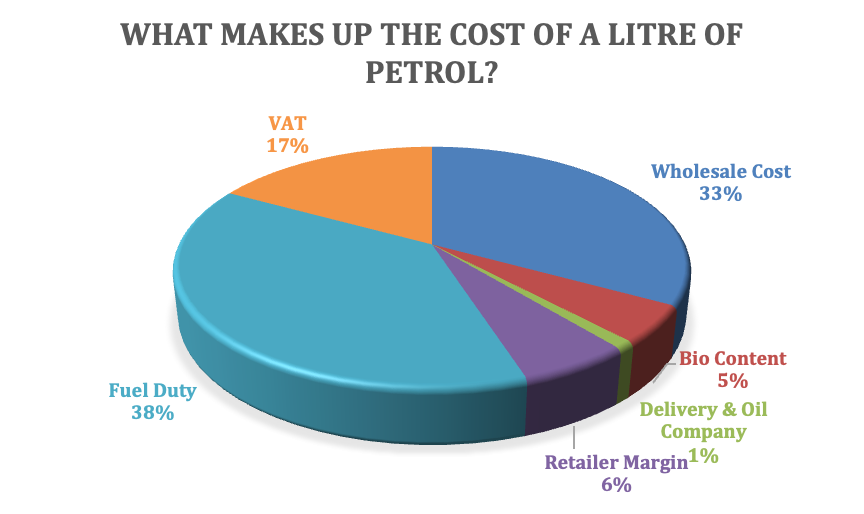
Fuel duty alone is currently 52.95 pence per litre, and VAT is charged at 20% on the total price, including the duty. This means around 56% of the price of petrol in the UK is tax.
Electricity Costs: The Energy Is Only Part of the Bill
Electricity prices in the UK follow a similar pattern. Many people assume electricity bills mainly reflect the cost of generating power. However, for most consumers, the wholesale cost of electricity accounts for only part of the final bill.
A typical electricity price can broadly be split into:
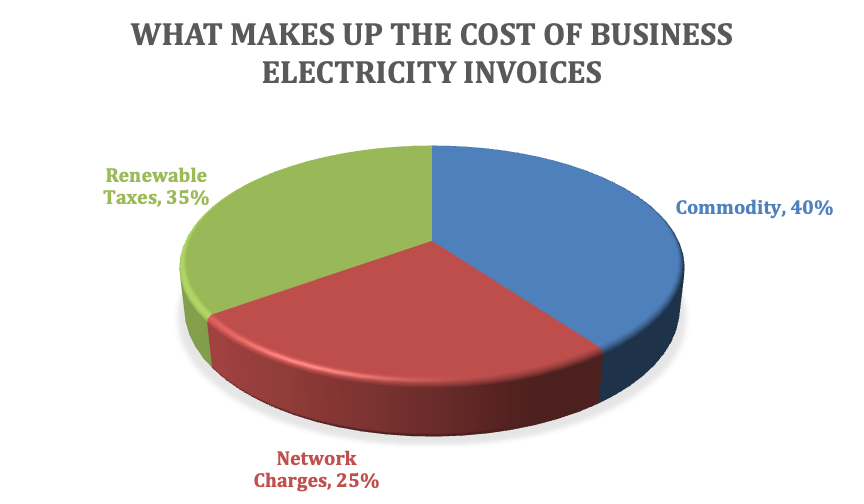
These non-commodity costs include transmission and distribution networks, system balancing services, environmental and social policy levies, capacity market payments and supplier operating costs.
Why the UK Has High Energy Costs
There are several structural reasons why energy prices in the UK are relatively high:
1. Energy taxation – Transport fuels are heavily taxed through fuel duty and VAT.
2. Policy and environmental costs – Electricity prices include the costs of decarbonisation policies and renewable support schemes.
3. Network infrastructure – Maintaining and expanding the national grid requires significant investment.
4. Market structure – The UK energy market includes a complex set of charges designed to ensure security of supply and support energy transition goals.
What This Means for Businesses
For organisations managing large energy consumption, this structure creates an important insight: reducing exposure to energy price volatility requires more than simply buying energy well.
Many of the biggest cost drivers sit outside the wholesale market. Effective energy management increasingly requires visibility across network charges, policy costs, carbon pricing and energy consumption patterns.
Simplifying Energy Cost Visibility
At GLEG, we work with large and complex energy users to simplify energy data and provide clear financial and carbon insights. By translating complex energy charges into understandable reporting, organisations can make better decisions about energy procurement, cost reduction and long-term decarbonisation strategy.
As the energy system becomes more complex, understanding what drives energy costs is becoming more important than ever.
At GLEG, we support organisations navigating complex regulatory landscapes and evolving geopolitical risks. Contact us today at hello@gleg.co.uk to see how we can support your business!