

Renewing Your Business Energy Contract Before April 2027?
September 17, 2026
Could Your Business Reduce Its Electricity Costs Through the EII Scheme?
September 23, 2026

UK Energy Market Summary to Friday 18th September 2026
Closing prices 18.09.2026

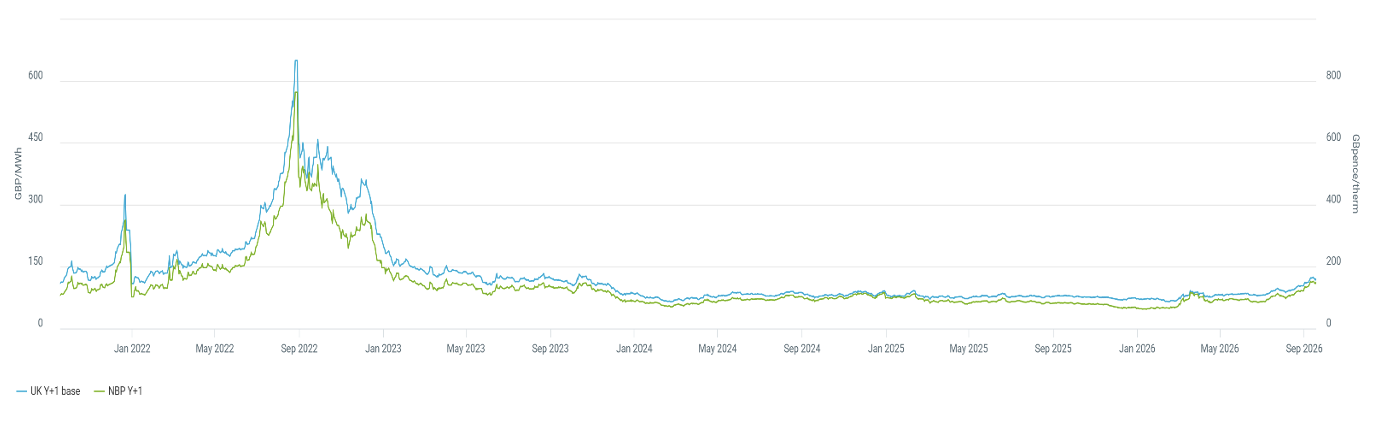
Wholesale gas, power and oil markets remained highly volatile during the week ending 18th September but finished slightly lower overall. UK NBP day-ahead gas settled broadly unchanged at approximately 198.3p/therm, while Winter-26 gas declined by approximately 3.4% to 199.1p/therm. UK Winter-26 electricity eased by approximately 1.3% to £158.95/MWh, while Brent crude fell by approximately 0.7% to $103.87/bbl. Middle East hostilities, restricted Gulf exports, Norwegian maintenance and low European storage continued to support prices.
European gas storage increased to approximately 69.1%, but remained materially below the five-year seasonal average of 85.1%. Germany and the Netherlands remained particularly weak at approximately 56.1% and 54.1% respectively. Europe therefore remains dependent on reliable Norwegian flows, sufficient LNG availability and manageable winter demand. The forward curve remains strongly backwardated, with Calendar-28 gas at approximately 86p/therm and electricity at £76/MWh – materially below near-term prices.
Contracts from 2028 onwards continue to offer more attractive absolute value. Electricity for 2028–2030 traded at approximately 6.8p to 8.1p/kWh, while gas traded at approximately 2.4p to 3.1p/kWh. Businesses should consider securing a measured proportion of future requirements where these levels support budgets, improving long-term cost certainty while retaining flexibility should storage improve or geopolitical risks ease.
Curve UK Gas & Electricity Markets

Other Energy Markets
Other News
Brent crude declined by approximately 0.7% during the week to $103.87/bbl, although prices briefly approached $109/bbl following attacks on Saudi Arabia’s East–West pipeline. Prices subsequently eased as alternative exports were arranged and China urged Iran to help restrain further attacks. However, restricted tanker movements through the Strait of Hormuz and continuing infrastructure disruption kept a substantial geopolitical premium priced into the market.